Best AI Tools for Marketers in 2026: The Complete Demand Gen Stack
(更新: )
The best AI tools for marketers in 2026 address the full demand generation pipeline: Copy.ai for ad copy, email sequences, and landing page content; Synthesia for video ads and explainers without a production crew; and ElevenLabs for realistic voiceover across video campaigns and podcast sponsorships. Supporting tools — HubSpot for CRM automation, Surfer SEO for content optimization, Canva for creative assets, and Make for workflow glue — fill the gaps across channels.
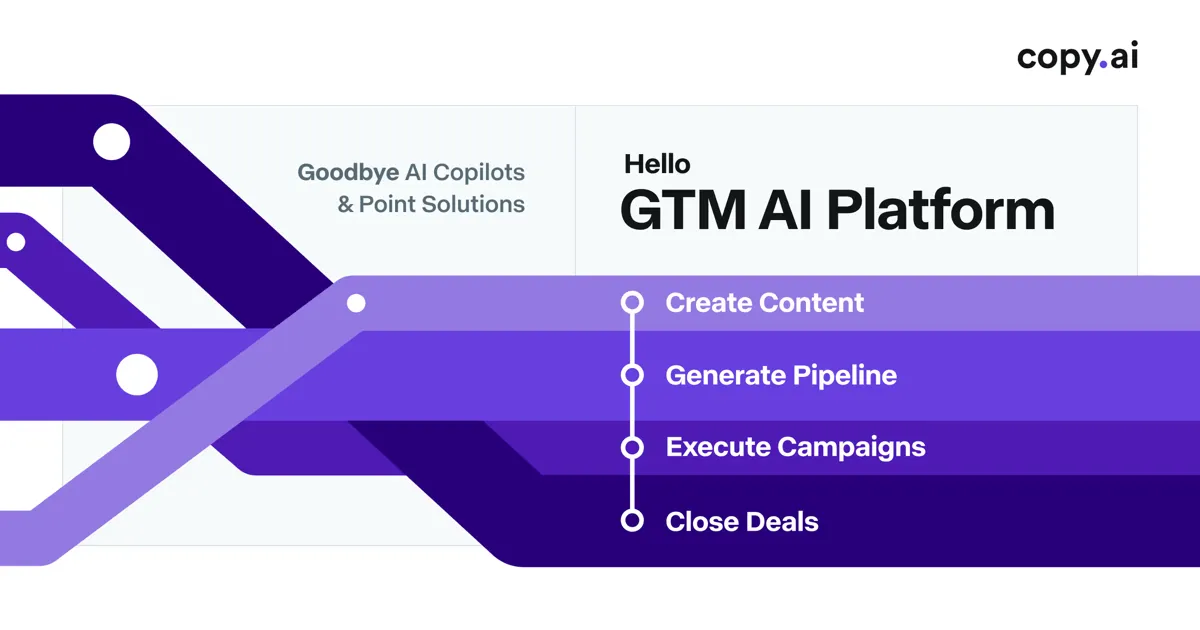
Source: Copy.ai official site (copy.ai)
Core stack (up front): Copywriting and email → Copy.ai. Video ads and explainers → Synthesia. Voiceover for video and audio ads → ElevenLabs. SEO content planning → Surfer SEO. Social scheduling → Buffer or Hootsuite. CRM and email automation → HubSpot or Mailchimp. Repurposing video → Opus Clip. Workflow integration → Make.
What AI tools do marketing teams use?
The tools that have gained real adoption across marketing functions in 2026 span four categories: copy generation (Copy.ai, Jasper, ChatGPT), video production (Synthesia, HeyGen), voice and audio (ElevenLabs), and SEO and analytics (Surfer SEO, Semrush, GA4 with AI features). The stack that makes sense for your team depends on which channels you own and where production bottlenecks are highest.
AI tools by marketing function
| Marketing function | Primary AI tool | Supporting tools |
|---|---|---|
| Ad copywriting (search, social, display) | Copy.ai | Jasper, ChatGPT |
| Email sequences and nurture | Copy.ai | HubSpot AI, Mailchimp |
| SEO content planning | Surfer SEO | Clearscope, ChatGPT |
| Social content | Copy.ai, Canva | Buffer, Hootsuite |
| Video ads and explainers | Synthesia | HeyGen, Opus Clip |
| Voiceover and audio ads | ElevenLabs | Murf AI |
| Analytics and reporting | GA4, Semrush | Supermetrics, Looker Studio |
| Workflow automation | Make | Zapier, HubSpot workflows |
Based on publicly available product information as of June 2026. Verify current features on each vendor’s site.
Copywriting and ad copy: where AI ROI is clearest
Ad copy and email are the highest-ROI entry points for AI in marketing. The volume is high, the formats are structured, and the quality bar — while important — is well within current AI capability when combined with human review.
Copy.ai: the GTM copy platform for marketing teams
Copy.ai has moved well past its origins as a headline generator. The current product is a GTM AI Platform with a workflow layer that generates coordinated copy across formats — ads, email, landing pages, social, and sales enablement — from a single brief or product description.
For marketing teams specifically, the most valuable capabilities are:
Ad copy at scale: Generate Google Ads headline and description variants, Facebook/Meta ad copy with multiple angles, and display ad copy for A/B testing — all from the same product brief. Variant generation at volume is where dedicated marketing tools beat general-purpose AI assistants.
Email sequence generation: Cold outreach sequences, lead nurture flows, re-engagement campaigns, and onboarding emails. Copy.ai’s email templates are structured around marketing goals rather than generic prose, which shortens the gap between generated output and publish-ready copy.
Workflow automation (paid plans): The Workflows feature is the key differentiator for teams at volume. Build a pipeline that takes a product update as input and outputs a press release, a LinkedIn post, a cold email, a Google Ads variation, and a newsletter section — all in one run without manual copy-paste between tools.
Brand Voice settings: Define your brand tone, terminology, and messaging guardrails once; all outputs respect those settings across the entire team.
Key limitations:
- Long-form blog generation is less polished than AI writing tools like Jasper or Clearscope that integrate SEO keyword data
- Team and enterprise pricing is contact-sales — verify current rates at copy.ai/pricing
- Generated copy still requires human review and testing before committing ad spend
Best for: Marketing teams running paid ads, email campaigns, and multi-channel content who need volume and consistency without separate tools for each format. For an in-depth breakdown of Copy.ai’s plans and workflow features, see our Copy.ai review.
Email marketing: combining AI copy with automation platforms
Email remains the highest-ROI channel in most B2B and e-commerce marketing stacks, and AI has accelerated two distinct parts of the workflow: copy generation and send-time optimization.
Copy.ai handles copy generation — subject lines, body copy, CTA variations, and full sequence drafts. It integrates with HubSpot and supports export to Mailchimp, so generated copy can flow into your existing automation platform rather than requiring a separate tool.
HubSpot (with AI content assistant) and Mailchimp (AI-assisted subject line generation and send-time optimization) handle the delivery, segmentation, and automation layer. These are not replacements for dedicated AI writing tools — their AI features are narrower — but they reduce the friction of pushing generated copy into live campaigns.
The practical workflow for most teams: generate copy variants in Copy.ai → review and edit → push to HubSpot or Mailchimp for sequence building → test subject lines with send-time optimization → iterate based on open and click data.
SEO and content: AI-assisted production within a broader strategy
AI has significantly accelerated content production for SEO without replacing the strategic layer — keyword research, topic prioritization, and internal linking structure still require human judgment informed by actual search data.
Surfer SEO is the most widely adopted AI-assisted content optimization tool in this category. It integrates keyword data and NLP analysis directly into the content editor, providing real-time guidance on topic coverage, word count, and semantic relevance as you write. The result is content that is structurally optimized for search at draft time rather than after-the-fact.
Clearscope is a strong alternative with a cleaner editor interface and similar keyword analysis depth — better suited to teams producing long-form editorial content at scale.
ChatGPT and Jasper handle initial drafting, outline generation, and content brief creation. Neither provides integrated SEO data, so they work best upstream of Surfer SEO or Clearscope rather than as standalone content tools.
For AI search optimization specifically (Google AI Overviews, Perplexity, ChatGPT citations), the requirements shift toward clear question-answer structure, sourced claims, and self-contained passages — more a content organization problem than a keyword density problem.
Social media: copy generation and repurposing
Social content benefits from AI primarily in two ways: generating platform-native copy variations from a single brief, and repurposing long-form assets into short-form clips and posts.
Copy.ai handles copy generation across platforms — LinkedIn posts, Twitter/X threads, Instagram captions, and TikTok descriptions — from a shared brief or campaign message. Brand Voice settings ensure consistency across channels even when posts are generated in bulk.
Canva (with AI features including Magic Design and Magic Media) handles the visual layer. For most marketing teams, Canva’s integrated AI generation is the practical default — no separate image tool required.
Buffer and Hootsuite handle scheduling, analytics, and team approval workflows. Neither is an AI-first tool, but both have added AI writing assistance for caption generation and posting time optimization.
Opus Clip analyzes long-form video content (webinars, interviews, product demos) and generates short clips optimized for Reels, Shorts, and TikTok — with auto-captions and virality scoring. For marketing teams that produce video events or interviews, Opus Clip converts one asset into five to ten social pieces without manual editing.
Video ads and explainers: production without a crew
Synthesia: avatar-based video for marketing campaigns
Synthesia solves a specific production problem for marketing teams: you need a professional presenter video — product demo, ad creative, localized campaign asset — but you don’t have the budget or time to film, edit, and localize traditional footage.
Type a script, choose from 230+ AI avatars, select one of 140+ languages, apply a branded template, and export a finished video. For structured video ad formats — product explainers, feature announcements, localized campaign assets — this is a genuine production alternative to a video production agency.
Key strengths for marketers:
- 140+ language support with voice dubbing — localize a campaign video without re-filming or hiring voice actors in each market
- 200+ branded video templates covering product demos, ads, and training formats
- Custom Avatar creation from recorded footage — build a digital presenter of a spokesperson or team member for consistent brand presence
- SCORM output for B2B teams using Synthesia for sales enablement or product training alongside advertising
Key limitations:
- The avatar aesthetic is well-suited to explainer and corporate video formats; it does not work for lifestyle, documentary, or narrative advertising
- Not a replacement for footage-dependent campaigns where product or environment visuals are essential
- Custom Avatar and API access require higher-tier plans — verify at synthesia.io/pricing
Best for: B2B marketing teams running product demo campaigns, multilingual advertisers, and any team that needs structured explainer video at volume without traditional production overhead.
Alternatives: HeyGen (strong at lower price points, competitive avatar realism), Opus Clip (for repurposing existing footage into short-form ads rather than generating new video from script).
Voiceover for video and audio ads: where voice quality matters
ElevenLabs: professional voiceover for marketing campaigns
ElevenLabs is the AI voice generator that marketing teams reach for when voice quality affects brand perception. Its Turbo v2.5 model produces speech with natural pacing, tonal variation, and emotional register that distinguishes it from robotic TTS alternatives — relevant for ad formats where the voice is part of the brand experience.
For marketing use cases specifically:
Video ad narration: Replace expensive voice actor sessions for product demo videos, explainer ads, and brand videos. Generate multiple voice style variations for A/B testing without re-booking a studio.
Podcast sponsorship reads: AI-generated sponsorship reads in a consistent brand voice, with the option to clone the voice of a specific spokesperson from recorded audio.
Voice cloning for consistent brand presence: Instant Voice Cloning lets you build a “brand voice” from a short audio sample and maintain it across all video and audio ad formats without requiring the original speaker each time.
Multilingual campaigns: 70+ languages and regional accent options — useful for teams running campaigns across markets who need localized voiceover without per-language voice casting.
Key limitations:
- Commercial rights require a paid plan — free tier is not licensed for published advertising
- Voice cloning fidelity varies with sample quality and length; longer, cleaner samples produce better results
- For highly polished brand campaigns with strict sonic branding requirements, professional voice actors remain the quality ceiling
Best for: Marketing teams producing video ads, product demos, podcast sponsorships, and multilingual campaigns who need consistent, realistic voiceover without per-project voice actor costs.
Alternatives: Murf AI (polished studio aesthetic, strong for corporate and presentation-style narration), Play.ht (generous character limits at entry tier).
Analytics and automation: closing the loop
AI has entered analytics and marketing automation primarily through natural-language query interfaces and anomaly detection — features built into existing platforms rather than standalone tools.
Google Analytics 4 includes AI-powered anomaly detection and predictive metrics (purchase probability, churn probability for e-commerce). The natural-language reporting interface allows plain-English queries without building custom reports.
Semrush and Ahrefs both include AI writing and research assistance integrated into keyword research and competitive analysis workflows — reducing the context-switching between SEO tools and writing tools.
Make (formerly Integromat) is the workflow automation platform most marketing teams use to connect the AI tools above: Copy.ai output to HubSpot, Synthesia video export to cloud storage, GA4 data to Slack reporting, and so on. Zapier is the simpler alternative; Make offers more complex multi-step logic at a lower cost for high-volume workflows.
Supermetrics and Looker Studio handle data consolidation and reporting across paid ad platforms, GA4, and CRM systems — the analytics layer that tells you whether the AI-generated copy and video are actually performing.
Tool comparison: AI tools for marketing teams
| Tool | Primary use | Free tier | Approx. paid plans | Best for |
|---|---|---|---|---|
| Copy.ai | Ad/email/social copy | Yes (limited) | Multiple tiers | Multi-format copy at volume |
| Synthesia | Video ads and explainers | Yes (limited) | From ~$18–30/mo+ | Presenter video without filming |
| ElevenLabs | Voiceover and audio ads | Yes (10k chars/mo) | From ~$22/mo+ | Realistic narration, voice cloning |
| Jasper | Long-form blog content | No (trial only) | From ~$39/mo+ | SEO-oriented blog writing |
| Surfer SEO | Content optimization | No | From ~$89/mo+ | On-page SEO content scoring |
| Canva | Social and ad design | Yes | From ~$13/mo+ | Visual content for non-designers |
| HubSpot | CRM, email automation | Yes (CRM free) | Varies by hub | Full marketing automation |
| Make | Workflow integration | Yes (limited) | From ~$9/mo+ | Connecting tools across the stack |
| Opus Clip | Video repurposing | Free trial | Paid tiers available | Short-form clips from long content |
All pricing is approximate as of June 2026. Verify current rates on each vendor’s official pricing page before purchasing.
How to build your AI marketing stack
Start with the highest-volume bottleneck. If your team spends the most time on ad copy and email, Copy.ai pays back fastest. If video production costs are the primary constraint, Synthesia unlocks a new production model. If paid campaigns are running but voice quality in video ads is inconsistent, ElevenLabs solves that in isolation. Pick one constraint and solve it completely before adding another tool.
Integrate before you expand. The value of these tools compounds when they share data and copy. Copy.ai output that flows directly into HubSpot campaigns is more valuable than output that requires manual transfer. Synthesia video exports that automatically land in your content storage and trigger social scheduling are more valuable than standalone video files. Invest in the workflow layer (Make, Zapier, HubSpot integrations) before adding more standalone tools.
Check commercial licensing before campaign launch. Free tiers on Copy.ai, ElevenLabs, and Synthesia are not licensed for commercial advertising use. If you are running paid media, publishing brand content, or using AI-generated assets in client deliverables, you need a paid plan with explicit commercial rights. Read the terms — not just the plan name — before going live.
Test on real campaigns before committing to annual billing. Vendor demos use optimized inputs. Test each tool on your actual briefs, your actual product, and your actual audience before signing annual contracts. Most meaningful quality differences emerge on domain-specific content that differs from the tool’s training examples.
FAQ
What are the best AI tools for marketers in 2026?
The core AI marketing stack in 2026 covers four functions: ad and email copywriting (Copy.ai), video ad production (Synthesia), voiceover for video and podcast ads (ElevenLabs), and SEO content planning (Surfer SEO or Clearscope). Supporting tools — HubSpot for CRM and automation, Canva for creative assets, Make for workflow glue, and Opus Clip for repurposing video — complete the pipeline. Most marketing teams run five to eight tools matched to the channels they own.
What AI tools do marketing teams use for copywriting?
Marketing teams use Copy.ai as the primary AI copywriting platform for ads, email sequences, landing page copy, and social content. Copy.ai’s GTM AI Platform offers workflow automation that generates copy variants across formats from a single brief input. Jasper is a common alternative for long-form blog content. ChatGPT is widely used for ad-hoc copy ideation, though dedicated marketing tools like Copy.ai enforce brand voice and messaging frameworks more consistently.
Can AI generate video ads for marketing campaigns?
Yes. Synthesia generates professional presenter-style video ads without filming, using AI avatars, branded templates, and scripts you provide. It supports 140+ languages — useful for teams running multilingual campaigns. ElevenLabs handles the voiceover layer: realistic AI narration and voice cloning for video ads, radio-style audio ads, and podcast sponsorship reads. Together, these tools enable a text-to-video-ad pipeline that bypasses traditional video production costs.
What AI tool is best for email marketing copy?
Copy.ai is the strongest dedicated AI tool for email marketing copy in 2026. Its email-specific templates cover subject lines, cold outreach sequences, nurture campaigns, re-engagement emails, and newsletter content. The Workflows feature chains subject line generation, body copy, and CTA variations into a single automated run. For teams using HubSpot or Mailchimp, Copy.ai integrates with those platforms to push generated copy directly into campaigns without manual transfer.
How much does an AI marketing stack cost per month?
A complete AI marketing stack typically runs $100–$250/month depending on team size and tools selected. As rough guidance (verify on each vendor’s site): Copy.ai paid plans start for individual users and scale to team tiers; Synthesia’s Starter plan is under $30/month; ElevenLabs Creator tier is roughly $22/month. Analytics and SEO tools add to this. Many teams start with free tiers on each tool and upgrade the highest-volume use case first. Pricing changes frequently — check vendor pages before purchasing.
Pricing verified June 2026 — check vendor pages before purchasing. Based on publicly available information from each provider’s official website, pricing pages, and documentation as of June 2026. Feature assessments reference published product documentation and third-party comparisons. Last updated: June 25, 2026. Contains affiliate links (disclosure policy).