Best AI Tools for Small Businesses in 2026: Copy.ai, ElevenLabs, and More
(更新: )
The best AI tools for small businesses in 2026 span marketing, video, voice, automation, and productivity — covering the full range of workflows where a small team needs to do more without hiring additional staff. Copy.ai is the standout tool for marketing and sales copy: it generates product descriptions, email sequences, social captions, and GTM workflows in minutes, giving small business owners a content production capability that previously required a dedicated copywriter. ChatGPT and Claude handle broader document drafting; ElevenLabs produces AI voice for ads and explainers; Synthesia creates presenter-style videos without cameras; Zapier and Make automate cross-app workflows; and Fireflies.ai turns meetings into searchable transcripts with action items. The right stack depends on where your team currently loses the most time.
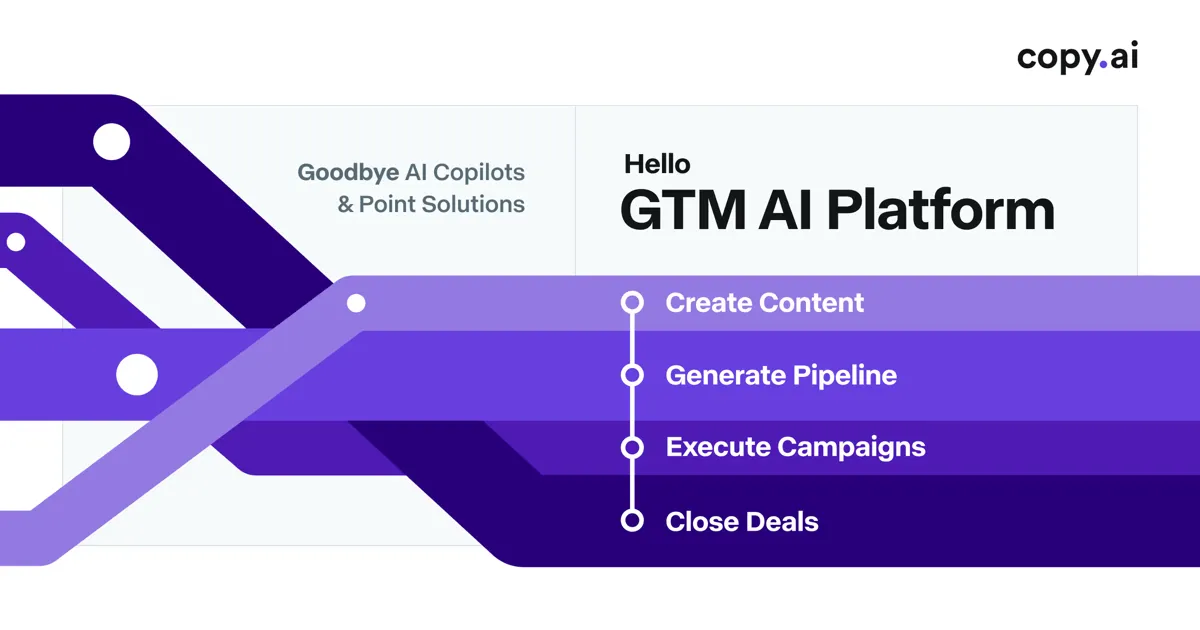
Source: Copy.ai official site (copy.ai)
Quick verdict: For marketing copy without a copywriter → Copy.ai. For AI voice in explainer videos or ads → ElevenLabs. For video without a camera or crew → Synthesia. For automating repetitive tasks between apps → Zapier or Make. For meeting transcription → Fireflies.ai.
Quick glance: best AI tools for small businesses
| Tool | Use case | Free tier | Best for |
|---|---|---|---|
| Copy.ai | Marketing copy, email sequences, social content | Yes (limited) | Small businesses producing regular marketing content |
| ChatGPT / Claude | General writing, drafting, customer emails | Yes | Owners who need flexible AI writing across many tasks |
| ElevenLabs | AI voice for videos, ads, explainers | Yes (~10k chars/mo) | Small businesses producing audio or video content |
| Synthesia | AI avatar videos for demos, training, comms | No | Teams needing video without cameras or actors |
| Zapier / Make | Workflow automation between apps | Yes (limited) | Businesses with repetitive cross-app tasks |
| Fireflies.ai | Meeting transcription, action item extraction | Yes (limited) | Teams that lose time recapping meetings and calls |
Verify current pricing and plan details at each vendor’s official site before subscribing.
1. Copy.ai
Copy.ai is the most purpose-built AI tool for small business marketing. Where general-purpose AI writers require heavy prompting, Copy.ai provides a template library designed specifically for commercial copy: product descriptions, email campaigns, social media captions, ad headlines, and outreach sequences. The Workflows feature lets teams build automated content pipelines — for example, feeding a product name and bullet points to produce a full set of marketing assets — without step-by-step manual prompting.
Key strengths:
- Templates purpose-built for marketing and sales copy — fewer blank-canvas prompts required
- Workflows feature automates content production pipelines on paid plans
- Brand Voice settings help maintain consistent tone across all output
- Integrations with common marketing and CRM platforms
Key limitations:
- Free plan is useful for testing but restrictive for regular content production — most small businesses will need a paid plan
- Long-form content (detailed blog posts, white papers) is less polished than specialized AI writing tools
- Verify current plan options and pricing at copy.ai before committing
Best for: Small business owners and solo marketers who need a steady output of product descriptions, social posts, email campaigns, and ad copy without hiring a dedicated copywriter. For a detailed review of Copy.ai’s templates and workflow features, see our Copy.ai review.
2. ChatGPT and Claude
ChatGPT (OpenAI) and Claude (Anthropic) are general-purpose AI assistants that handle a wide range of small business writing tasks. Unlike Copy.ai’s template-focused approach, these tools are better suited to open-ended tasks: drafting a response to a difficult customer email, writing a proposal, summarizing a contract, or outlining a new policy document. Both offer free tiers and paid subscription plans with higher usage limits and more advanced models.
Key strengths:
- Flexible across almost any writing or reasoning task — not limited to marketing use cases
- Strong at customer-facing writing: complaint responses, inquiry replies, onboarding emails
- Useful for internal documents: SOPs, policy drafts, meeting agendas, job descriptions
- Both offer free tiers for experimentation
Key limitations:
- Output quality depends heavily on how well you prompt — requires some practice to get consistent results
- Not specialized for high-volume commercial copy the way Copy.ai is
- Verify current pricing and plan options at openai.com and anthropic.com
Best for: Small business owners who need flexible AI writing assistance across many different task types rather than high-volume marketing copy specifically.
3. ElevenLabs
ElevenLabs produces AI voice that sounds natural enough for business use in explainer videos, product demos, customer support audio, and ads. For small businesses that want to produce video or audio content without hiring voice talent or booking a recording studio, it removes a significant cost and logistics barrier. It supports a wide range of languages, making it practical for businesses serving multilingual customers.
Key strengths:
- High-quality voice synthesis suitable for professional business content
- Voice cloning from a short audio sample for brand voice consistency
- Multi-language support for serving international or multilingual customers
- Free tier available for initial testing — verify at elevenlabs.io/pricing
Key limitations:
- Audio only — you will need a separate video editor or platform to combine ElevenLabs audio with visuals
- Voice cloning terms of service require careful review — always verify permitted use cases
- Paid plans scale with usage; verify current pricing at elevenlabs.io before committing
Best for: Small businesses producing explainer videos, product walkthrough narrations, customer support audio, or any content where professional voice-over previously required hiring external talent.
4. Synthesia
Synthesia generates AI avatar videos where a realistic digital presenter delivers a script on camera — without requiring an actual person on screen, a camera, or editing software. For small businesses that need training videos, product demos, or internal communications content on a recurring basis, it eliminates production overhead.
Key strengths:
- No camera, studio, or video editing skills required
- Library of AI avatars and backgrounds for varied presentation styles
- Supports multiple languages for localized training or customer content
- Useful for recurring content needs: onboarding videos, product updates, internal announcements
Key limitations:
- AI avatar quality varies — may not suit brand contexts where authenticity or personal connection matters most
- No free plan — verify current pricing and trial options at synthesia.io
- Not a good fit for social-media-style video where authentic creator presence is expected
Best for: Small businesses that need regular video content for product demos, employee training, or internal communications without investing in video production equipment or staff.
5. Zapier and Make
Zapier and Make (formerly Integromat) are workflow automation platforms that connect the apps a small business already uses — CRM, email, Slack, spreadsheets, ecommerce platforms — and trigger actions automatically when conditions are met. Neither is an AI tool in the generative sense, but both now include AI steps that can summarize, classify, or generate text as part of a workflow. The practical value for small businesses is eliminating repetitive manual tasks: auto-creating CRM records from form submissions, routing lead notifications, generating draft emails from new orders, or syncing data between platforms.
Key strengths:
- Connects thousands of apps without requiring custom code
- AI actions (via OpenAI or other integrations) allow content generation steps inside workflows
- Both offer free tiers with limited workflow runs — useful for starting small
- Zapier is more beginner-friendly; Make offers more complex branching logic at lower price points
Key limitations:
- More complex automations require careful setup and occasional maintenance
- AI steps add API costs on top of platform subscription fees
- Verify current pricing at zapier.com and make.com — task/operation limits vary significantly by plan
Best for: Small businesses with repetitive manual tasks between multiple apps — especially lead management, ecommerce order processing, or internal notification workflows.
6. Fireflies.ai
Fireflies.ai joins your video calls (Zoom, Google Meet, Microsoft Teams) and automatically records, transcribes, and summarizes meetings. After each call, it generates searchable transcripts, extracts action items, and can push notes to your CRM or project management tool. For small businesses where team members are also the main sales and delivery staff, it removes the burden of manual note-taking and ensures action items from meetings actually get captured.
Key strengths:
- Automatic transcription for Zoom, Google Meet, Teams, and other platforms
- AI-generated meeting summaries and action item extraction
- Searchable meeting archive — find what was said in any past call
- CRM integrations to push notes directly to contact records
Key limitations:
- Transcription accuracy depends on audio quality and accent — review before relying on AI-extracted action items for critical decisions
- Free plan has limited transcription credits — verify at fireflies.ai/pricing
- Meeting bot attendance may require attendee consent depending on jurisdiction — verify local recording laws
Best for: Small business owners and sales teams who lose time after meetings writing up notes, following up on action items, or trying to recall what was agreed.
Which tool should your small business start with?
FAQ
What is the best AI tool for small business marketing?
Copy.ai is widely used for small business marketing copy — it generates product descriptions, email sequences, social captions, and ad copy with templates designed specifically for commercial use. Verify current plans and pricing at copy.ai before committing to a subscription.
Can AI tools help small businesses with customer service?
Yes — AI chatbots such as Intercom Fin or Freshdesk AI can handle common inbound queries automatically. Meeting transcription tools like Fireflies.ai help service teams capture and follow up on customer calls. ElevenLabs can produce consistent customer support audio without hiring voice talent. Effectiveness depends on your specific use case and team size.
What AI tools help with small business productivity?
ChatGPT and Claude handle general writing and document drafting across many business contexts. Zapier and Make automate repetitive tasks between apps, reducing manual data entry and handoff steps. Fireflies.ai transcribes meetings and extracts action items automatically, reducing post-meeting administrative overhead.
Is Copy.ai free for small businesses?
Copy.ai offers a free plan with limited monthly outputs. Paid plans unlock higher usage limits and the Workflows feature for automated content pipelines. Verify current pricing and plan details at copy.ai before committing to a subscription — plan limits and pricing change over time.
Can small businesses use AI video tools affordably?
Yes — Synthesia and HeyGen both offer plans aimed at small teams for creating product demos, explainer videos, and training content without a studio or on-camera talent. The cost is significantly lower than traditional video production. Verify current pricing at each vendor’s site before purchasing, as plans and included credits vary.
Bottom line
The best AI tools for small businesses in 2026 address specific workflow bottlenecks rather than replacing headcount wholesale. Copy.ai delivers the most direct value for marketing and sales copy — the category where most small businesses feel the resource pressure first. ElevenLabs and Synthesia remove production barriers for audio and video content. Zapier and Make eliminate repetitive cross-app tasks. Fireflies.ai closes the gap between meetings and follow-through. Start with the category where your team currently spends the most time on repeatable work, test on your actual tasks before paying, and expand from there.
Pricing verified June 2026 — check vendor page before purchasing. Contains affiliate links (disclosure policy).