Best AI Avatar Generators in 2026: Synthesia, HeyGen, and More Compared
(更新: )
AI avatar video generators let you create presenter-style videos from a text script — no camera, no studio, no on-screen talent required. Synthesia leads the category for enterprise use, with support for 140+ languages, a large library of stock avatars, and native integrations with major LMS platforms. HeyGen has built momentum with creators and small businesses by combining competitive avatar realism with an accessible interface and a video translation feature. Colossyan targets learning and development teams with SCORM export; D-ID focuses on API-driven talking-portrait generation for developers; and Runway brings generative video capabilities that complement avatar-based approaches. The right tool depends on whether your priority is multilingual enterprise training, creator-friendly video production, developer integration, or generative flexibility.
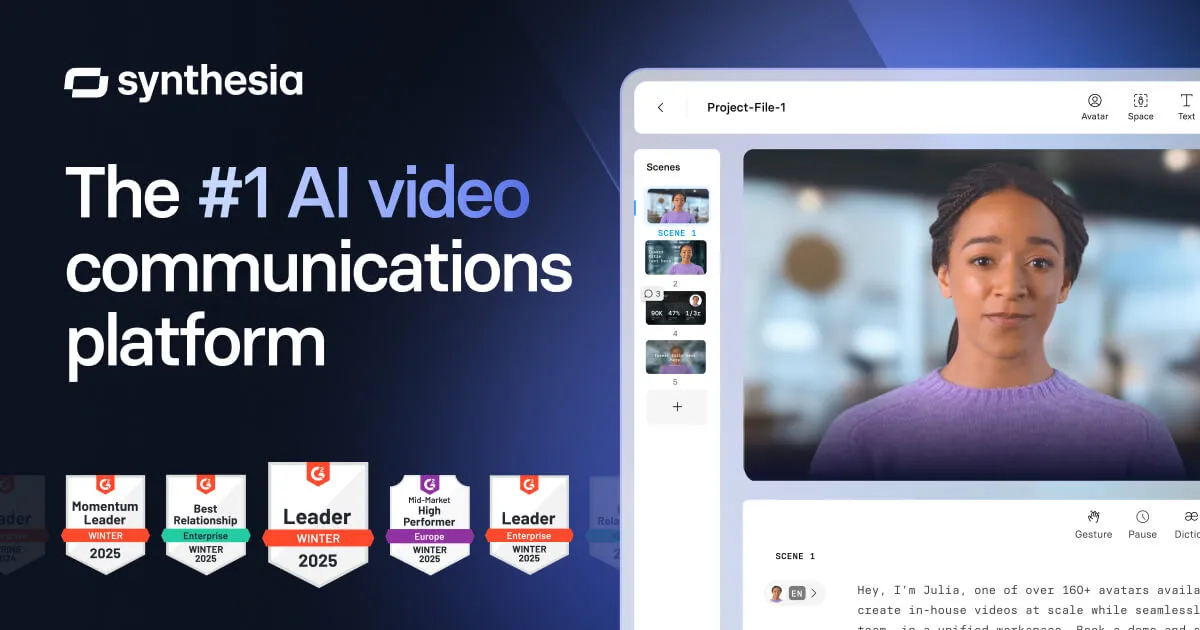
Source: Synthesia official site (synthesia.io)
Quick verdict: Choose Synthesia for enterprise L&D with multilingual requirements and LMS delivery pipelines. Choose HeyGen for creator or SMB workflows where competitive avatar quality at accessible pricing matters more than enterprise integrations. Choose Colossyan if your team needs SCORM export and a collaborative learning-content workspace. Choose D-ID if you need an API-driven talking-portrait solution to embed in your own application. Consider Runway if generative video — rather than scripted avatar presentation — is the goal.
AI avatar tools at a glance
| Tool | Language support | Avatar library | Best for | Free plan |
|---|---|---|---|---|
| Synthesia | 140+ | 230+ stock avatars | Enterprise L&D, multilingual training | Yes |
| HeyGen | 40+ | 100+ stock avatars | Creators, SMBs, video translation | Yes |
| Colossyan | Multiple | Stock avatars | L&D teams, SCORM delivery | Yes |
| D-ID | Multiple | Talking portraits from images | Developers, API integration | Yes |
| Runway | — | Not avatar-based | Creative generative video | Yes |
Pricing and feature details change frequently — verify current plans at each vendor’s site before purchasing.
1. Synthesia
Synthesia was built with enterprise training in mind, and its feature depth reflects that focus. You write or paste a script, select from 230+ AI-rendered stock presenters, choose a language and accent from 140+ options, and export a finished video — with no camera, recording studio, or on-screen talent involved. That workflow has made it the default choice for L&D teams producing compliance training, onboarding content, and product explainers across global organizations.
Strengths:
- 140+ languages with lip-sync dubbing — the same avatar can deliver the same training module credibly in dozens of markets without a re-shoot
- 230+ diverse stock avatars covering a wide range of demographics and presentation styles
- Native LMS integrations with Workday Learning, Cornerstone OnDemand, and iSpring for direct publishing into enterprise training pipelines
- Brand Kit to lock approved fonts, colors, and logo placement across all team-produced videos
- Custom Avatar creation from recorded source footage, available on paid plans
- Enterprise SSO for large-scale user provisioning
Limitations:
- Avatar-style video has a distinctive aesthetic that works well for training and explainers but is not suited for cinematic storytelling or fiction
- Custom avatars, API access, and SSO sit behind higher-tier plans
- Free plan limits are modest — sufficient for evaluation, not production volume
Best for: Corporate training, compliance video, product explainers, HR onboarding, and any workflow where you need a scripted presenter at scale without the cost of human recording.
2. HeyGen
HeyGen is the closest direct competitor to Synthesia in the avatar video space — for a detailed side-by-side, see Synthesia vs HeyGen — and it has grown quickly by focusing on accessibility for individual creators and smaller teams. Its stock avatar quality is competitive, pricing at entry tiers is more accessible than Synthesia’s enterprise positioning, and its Video Translation feature — lip-sync dubbing for existing footage in 40+ languages — is a differentiator for teams that already have recorded content they want to localize.
Strengths:
- Competitive avatar realism, particularly at lower price tiers
- Video Translation with lip-sync dubbing in 40+ languages for localizing existing footage
- Talking Photo feature to animate a still image to speak from a script
- Custom avatar creation from recorded footage on paid plans
- More accessible entry pricing for individual creators and small teams
Limitations:
- Fewer enterprise integrations than Synthesia — LMS connectivity is more limited
- 40+ language coverage is strong but narrower than Synthesia’s 140+
- Custom avatar terms and quality vary — review documentation carefully before creating an avatar of a real person
Best for: Creators, marketers, and SMBs that want strong avatar video quality and a video translation capability without enterprise pricing.
3. Colossyan
Colossyan positions itself specifically for learning and development teams. Where Synthesia competes broadly across enterprise use cases, Colossyan focuses on the L&D workflow — collaborative video creation, SCORM export for LMS delivery, and a workspace designed for teams producing training content at volume. It is worth evaluating if SCORM compatibility and a purpose-built L&D interface matter more to your team than the broadest possible avatar library or the deepest language support.
Strengths:
- SCORM export for direct delivery into LMS platforms that require it
- Collaborative workspace built for L&D teams working on training content together
- Focused feature set tuned to training content formats
Limitations:
- Narrower language and avatar coverage than Synthesia
- Less recognized outside the L&D vertical compared to Synthesia or HeyGen
- Verify current integrations and pricing — the L&D tooling market moves fast
Best for: L&D teams and instructional designers who need SCORM-compatible output and a collaborative production workspace for training content.
4. D-ID
D-ID takes a different approach from the other tools in this list: it is primarily API-first and focused on animating still images — turning a photograph or portrait into a talking, lip-synced video presenter. This makes it the strongest option for developers building avatar-powered features into their own applications rather than using a standalone video creation interface. D-ID’s web app also offers a more accessible interface for non-developers, but its core differentiation is the API and the talking-portrait capability.
Strengths:
- API-first architecture suited to developers embedding talking-avatar features in applications
- Talking-portrait animation from a still image — no video shoot required
- Broad input flexibility for source imagery
- Available free tier for testing API integration
Limitations:
- Less suited to high-volume scripted training production than Synthesia or Colossyan
- Portrait-based avatars have a different aesthetic from purpose-built stock avatars
- Not the primary choice for teams that want a polished standalone video creation interface
Best for: Developers building avatar-powered features into apps, teams needing to animate existing photos or portraits, and use cases where API access is the priority.
5. Runway
Runway occupies a different category from the other tools on this list. Rather than generating a scripted avatar presenter, Runway uses generative AI to create original video footage from text prompts — cinematic scenes, visual sequences, and stylized motion rather than a human presenter reading a script. It is relevant here because some teams are beginning to combine generative footage with scripted avatar video rather than relying on either alone. For pure avatar video production — scripted presenters, training content, multilingual delivery — Runway is not the right primary tool.
Strengths:
- Leading generative video quality for cinematic and creative production
- Video-to-video transformation tools for restyling existing footage
- Camera control and motion tools for directing generated footage
- Strong base in professional creative production
Limitations:
- Not an avatar generator in the traditional sense — no scripted presenter, no LMS integration
- Creative generative output is not suited to compliance training or scripted onboarding video
- Prompt engineering for consistent results has a learning curve
Best for: Creative professionals, filmmakers, and marketers who need AI-generated footage for campaigns, trailers, or experimental content — not for scripted presenter video.
Which tool fits your use case?
| Use case | Recommended tool |
|---|---|
| Enterprise L&D with multilingual requirements | Synthesia |
| Compliance training delivered via LMS | Synthesia or Colossyan |
| Creator or SMB avatar video | HeyGen |
| Video translation of existing footage | HeyGen |
| SCORM export for training content | Colossyan |
| Talking portrait from a still photo | D-ID |
| Developer API for avatar features in apps | D-ID |
| Generative cinematic video | Runway |
If multilingual reach and LMS delivery are central to your workflow, Synthesia is the clearest starting point — our Synthesia review covers pricing and feature depth in detail. For teams with more focused needs — SCORM output, API integration, or creative generative footage — Colossyan, D-ID, and Runway each address a narrower but well-defined use case.
Which AI avatar generator should you choose?
FAQ
What is the best AI avatar generator in 2026?
Synthesia is the leading choice for enterprise training and multilingual content production. Its 140+ language support, 230+ stock avatar library, and native LMS integrations give it a clear advantage for organizations that need scalable, consistent video across global teams. HeyGen is the strongest alternative for creators and smaller teams that want competitive avatar quality with more accessible pricing and a video translation feature — see our HeyGen alternatives guide for a broader competitive view. The right answer depends on whether your primary need is enterprise L&D infrastructure or accessible creator-friendly production.
Can I create a custom AI avatar of myself?
Yes — Synthesia, HeyGen, and D-ID all support custom avatar creation from recorded footage on paid plans. The process typically involves recording source video that meets the platform’s quality and length requirements, after which the platform trains an avatar model on your appearance and voice. Requirements vary significantly between platforms, so check each vendor’s current documentation before recording source material. Always review the platform’s terms regarding consent, data handling, and commercial use rights before creating an avatar of a real person.
Does Synthesia offer a free plan?
Yes. Synthesia has a free plan that lets you create a limited number of videos to evaluate the platform before committing to a paid subscription. The free plan is useful for testing a representative script in your target language and assessing avatar quality against your actual content. Paid plan pricing and feature tiers change periodically — visit synthesia.io for current rates and plan limits before purchasing.
Which AI avatar tool supports the most languages?
Synthesia supports 140+ languages with lip-sync dubbing, which is the broadest coverage in this comparison. HeyGen supports 40+ languages. D-ID and Colossyan offer multilingual support as well, but at narrower coverage than Synthesia’s range. For organizations that need to deliver the same training content across many language markets credibly — with lip-sync matching the target language rather than just subtitles — Synthesia’s language depth is a meaningful differentiator.
Are AI avatar videos convincing enough for professional use?
For the use cases these tools are designed for — corporate training, compliance video, product explainers, HR onboarding, and internal communications — the output from Synthesia and HeyGen is broadly suitable for professional deployment. Avatar realism has improved significantly and leading platforms now produce natural lip-sync and subtle facial expression. For customer-facing brand advertising or high-stakes external video, human review of output before publishing is advisable, and results will vary by plan tier and the specific avatar chosen. Testing with your own representative script — rather than a vendor demo — is the most reliable way to assess output quality before committing.
Pricing verified June 2026 — check vendor pages before purchasing. Feature information based on publicly available product documentation. Contains affiliate links (disclosure policy).